Clay shrinkage and swelling

Understanding the risk

Soils containing clay swell when exposed to water (during the rainy season) and shrink during dry periods. These movements can damage buildings, causing cracks. Detached houses that have not been designed to withstand movement in clay soils can suffer significant damage. This is why clay shrinkage and swelling is regarded as a natural hazard. Climate change, with increasingly severe periods of drought, heightens this risk.

What to do

Before: preventing damage

  • Commission a preliminary or design-stage geotechnical survey to ensure that construction methods and design choices reflect any potential ground-related risks. This survey is required in areas with medium or high exposure when entering into a contract for the sale of a building plot or for construction work.
  • Keep large trees away from buildings. If trees are already present, consider installing root barriers.
  • Install an impermeable strip around your home (paving or a geomembrane) to prevent water from seeping into, or evaporating from, the ground at the base of the walls.
  • Ensure rainwater drains away properly: check that it is channelled away from your home. Guttering must never discharge directly onto the ground.
  • Check underground pipes for leaks. An unexplained rise in water consumption may indicate a leak that is weakening the ground.

During and afterwards: responding to damage

If the ground shrinks and places strain on the building, take the following steps without delay:

  • Notify your insurer of the damage, without waiting for the official natural disaster declaration to be published.
  • Report the damage to the Mairie de Cannes, which will ask the Préfet des Alpes-Maritimes to seek official recognition of a natural disaster.
  • Await publication of the interministerial order recognising a natural disaster in the Journal officiel (available at www.legifrance.gouv.fr).
  • Following publication of the order in the Journal officiel, submit your final claim to your insurer within 30 days. Supporting documents should include your contact details and insurance policy number, the date and precise nature of the incident, a detailed description of the damage, an initial estimate of losses, photographs of the damage, invoices and repair quotations.
  • Wait for an accredited loss adjuster to assess the cost of the damage before undertaking permanent repairs. Cracks may develop further as seasonal conditions change.

Provided the conditions of cover are met, compensation is paid within three months of submission of the estimated statement of losses and publication of the interministerial natural disaster order.

Property covered by insurance: buildings and permanent structures, including walls, floors, ceilings, fixed installations, fences, gates and outbuildings.

Stay informed and protect yourself

Register for Cannes Alerte

The city hall has introduced a system to notify residents by telephone in the event of an alert.

To register, simply complete the dedicated form and choose how you would like to be contacted in the event of an alert.

By clicking the button below, you will leave Cannes.com and be taken to a secure external page.

register for alerts


You can also follow weather alerts in real time via the myPredict2 app.

Other alert systems: sirens, announcements over loudspeakers, digital screens across the town…

Stay informed in real rime during an alert

Consult Cannes’ Document d’information communal sur les risques majeurs (DICRIM)

Cannes is exposed to 20 major risks. To raise awareness among all residents of the different types of risk and the appropriate actions that can save lives, the Mairie de Cannes has published its Document d’information communal sur les risques majeurs (DICRIM), a municipal guide to major risks.

Download the document (FR)

Prepare your 72-hour emergency kit

The 72-Hour Emergency Kit

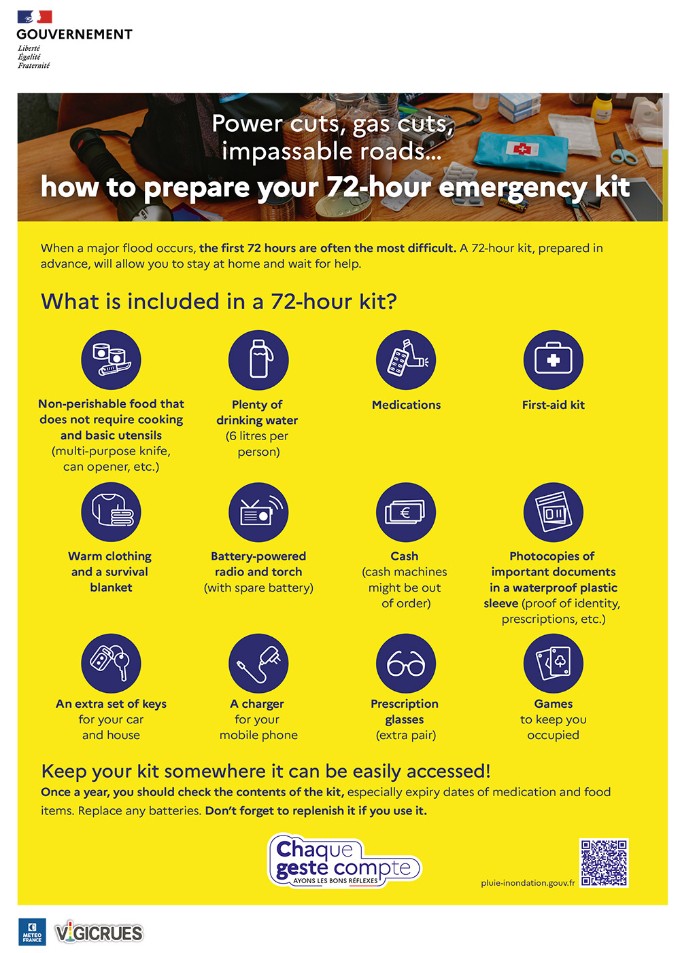
Power cuts, disruptions to gas and running water supplies, impassable roads… when a major disaster strikes, the first 72 hours are often the most challenging. Preparing this kit in advance will help you stay at home with greater peace of mind while waiting for help to arrive. It will also be invaluable if you need to leave at short notice.

Here is what to include in your kit:

  • a battery-powered radio (with spare batteries) to follow instructions from the authorities
  • medications
  • a first aid kit (antiseptic, plasters, sterile dressings…)
  • basic tools (a multi-tool, tin opener…)
  • non-perishable food that requires no cooking (tinned food, jars of baby food, pet food…)
  • warm clothing and an emergency blanket
  • a torch (with spare batteries), candles, a lighter or matches
  • a mobile phone charger
  • a spare pair of prescription glasses
  • cash (cash machines may be out of service)
  • plenty of bottled drinking water (6 litres per person)
  • photocopies of essential documents in a waterproof pouch (identity card, prescriptions…)
  • spare house and car keys
  • games to pass the time.

Keep the bag somewhere easily accessible.
Check the contents of your kit once a year, particularly the expiry dates of medication and food. Replace the batteries too.

Remember to replenish your kit after use!
More information

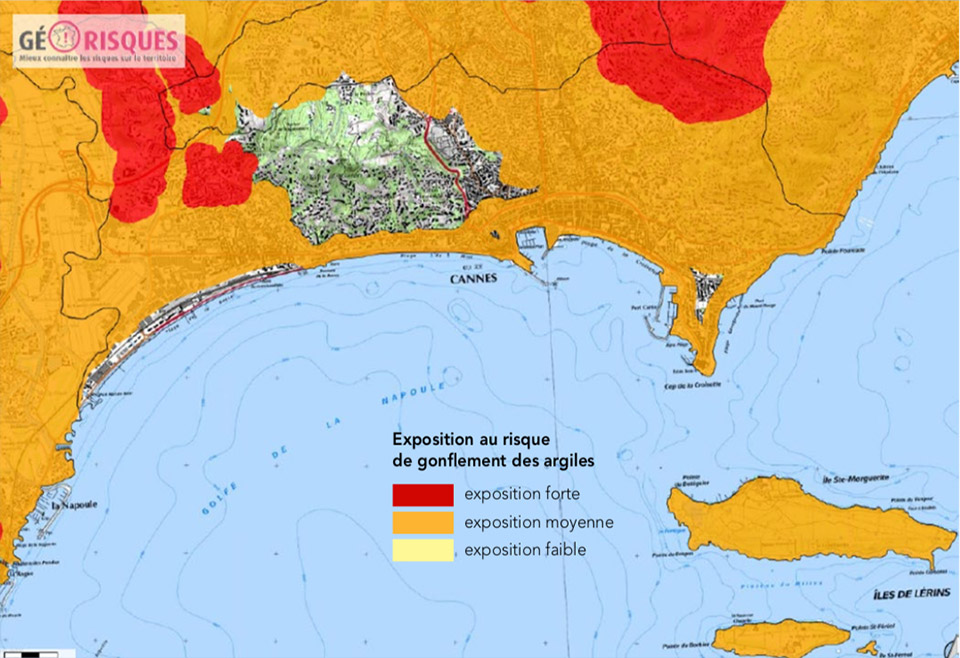
Clay shrinkage and swelling risk in Cannes

The areas most exposed are the Californie hillside, the Siagne plain, Bocca Nord, Pointe Croisette and the îles de Lérins. The remaining areas have a medium level of exposure, with the exception of the Croix-des-Gardes massif, which is unaffected.

Since 1993, five orders recognising a natural disaster have been issued in Cannes for ground movements and landslides.


Preventing the risk

The Mairie de Cannes and the Agglomération Cannes Lérins undertake practical measures to prevent this risk. For further information, consult the DICRIM.


Introducing preventive measures
  • A geotechnical constraints plan, appended to the Plan local d’urbanisme (Local Development Plan), requires a geotechnical survey in low- and medium-risk areas to identify the construction measures needed to protect against the risks identified. Construction in high-risk areas is strictly regulated.
  • A preliminary or design-stage geotechnical survey addressing clay shrinkage and swelling is required in areas with medium or high exposure when entering into a contract for the sale of a building plot or for construction work.