Tsunami

A tsunami consists of a series of waves that can reach several metres in height.

Understanding the nature of the risk

A tsunami can be caused by:

  • A shallow undersea earthquake with a magnitude of at least 6.5. The amplitude of the resulting tsunami increases with the magnitude of the earthquake.
  • An underwater landslide, causing the sudden displacement of a mass of water at depth and the formation of a surface wave.

What to do

Before a tsunami: stay alert

If you live in a coastal area, be alert to the following warning signs:

  • A strong or prolonged earthquake
  • An unusually rapid change in sea level
  • An unusual, deep rumbling sound
  • Move away from areas close to the coast and remain alert for any tsunami warning
  • Prepare by identifying a place where you can take shelter
  • Prepare essential items (medication, identity documents, a torch, etc.) for your emergency kit

During a tsunami: get to safety

If you are on land:

  • As soon as a warning is issued (via loudspeakers, text messages, sirens, etc.), move as far away from the coast as possible or seek higher ground to stay safe
  • Never go down to the beach to watch a tsunami
  • Do not put to sea under any circumstances
  • Only make telephone calls in a life-threatening emergency, to keep telephone networks available for the emergency services
  • Climb onto the roof of a building or to the top of a sturdy tree. As a last resort, hold on to a floating object carried by the tsunami
  • Follow the authorities’ instructions

If you are at sea:

  • If a tsunami warning is issued, do not return to port

After a tsunami: remain vigilant

  • Stay out of the danger zone until the authorities have issued an all-clear
  • If you are at sea, monitor communications from the authorities to ensure that conditions are safe for returning to port
  • Before using tap water for drinking, preparing food or cooking, check with the local authorities that it is safe to drink. In all cases, run the taps to flush the pipes and clear any stagnant water

Stay informed and protect yourself

Register for Cannes Alerte

The city hall has introduced a system to notify residents by telephone in the event of an alert.

To register, simply complete the dedicated form and choose how you would like to be contacted in the event of an alert.

By clicking the button below, you will leave Cannes.com and be taken to a secure external page.

register for alerts


You can also follow weather alerts in real time via the myPredict2 app.

Other alert systems: sirens, announcements over loudspeakers, digital screens across the town…

Stay informed in real rime during an alert

Consult Cannes’ Document d’information communal sur les risques majeurs (DICRIM)

Cannes is exposed to 20 major risks. To raise awareness among all residents of the different types of risk and the appropriate actions that can save lives, the Mairie de Cannes has published its Document d’information communal sur les risques majeurs (DICRIM), a municipal guide to major risks.

Download the document (FR)

Prepare your 72-hour emergency kit

The 72-Hour Emergency Kit

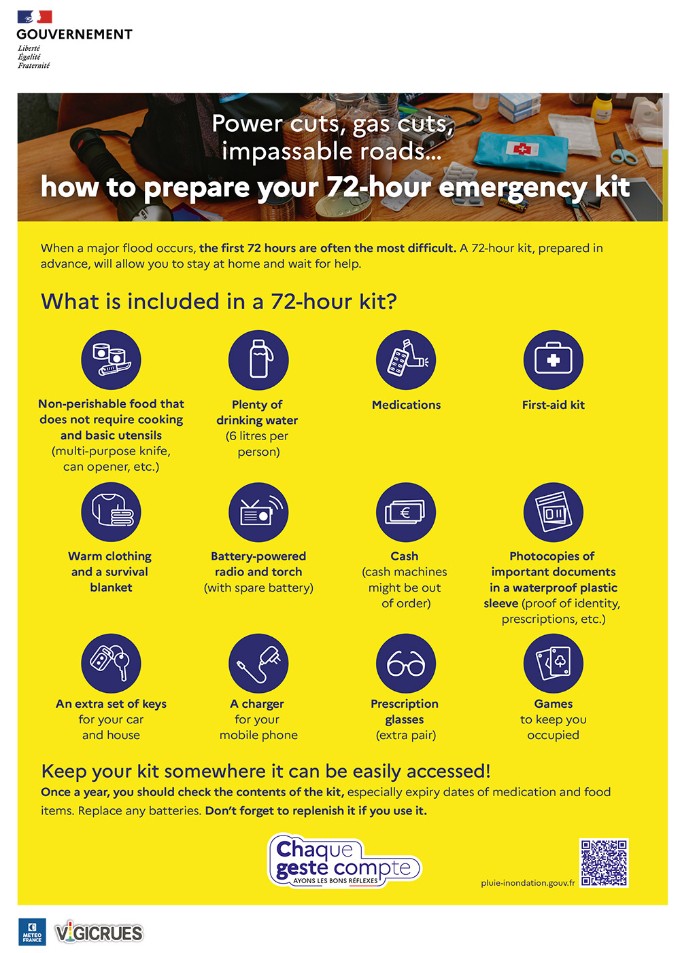
Power cuts, disruptions to gas and running water supplies, impassable roads… when a major disaster strikes, the first 72 hours are often the most challenging. Preparing this kit in advance will help you stay at home with greater peace of mind while waiting for help to arrive. It will also be invaluable if you need to leave at short notice.

Here is what to include in your kit:

  • a battery-powered radio (with spare batteries) to follow instructions from the authorities
  • medications
  • a first aid kit (antiseptic, plasters, sterile dressings…)
  • basic tools (a multi-tool, tin opener…)
  • non-perishable food that requires no cooking (tinned food, jars of baby food, pet food…)
  • warm clothing and an emergency blanket
  • a torch (with spare batteries), candles, a lighter or matches
  • a mobile phone charger
  • a spare pair of prescription glasses
  • cash (cash machines may be out of service)
  • plenty of bottled drinking water (6 litres per person)
  • photocopies of essential documents in a waterproof pouch (identity card, prescriptions…)
  • spare house and car keys
  • games to pass the time.

Keep the bag somewhere easily accessible.
Check the contents of your kit once a year, particularly the expiry dates of medication and food. Replace the batteries too.

Remember to replenish your kit after use!
More information

Tsunami risk in Cannes

Mediterranean coastlines are exposed to tsunami risk due to seismic activity in the Mediterranean basin. Although tsunamis are rare, the risk is real. The French Riviera coastline has already been affected by tsunamis in 1887 (the Ligurian earthquake), 1979 (an underwater landslide at Nice airport) and 2003 (an earthquake off the coast of Algeria).

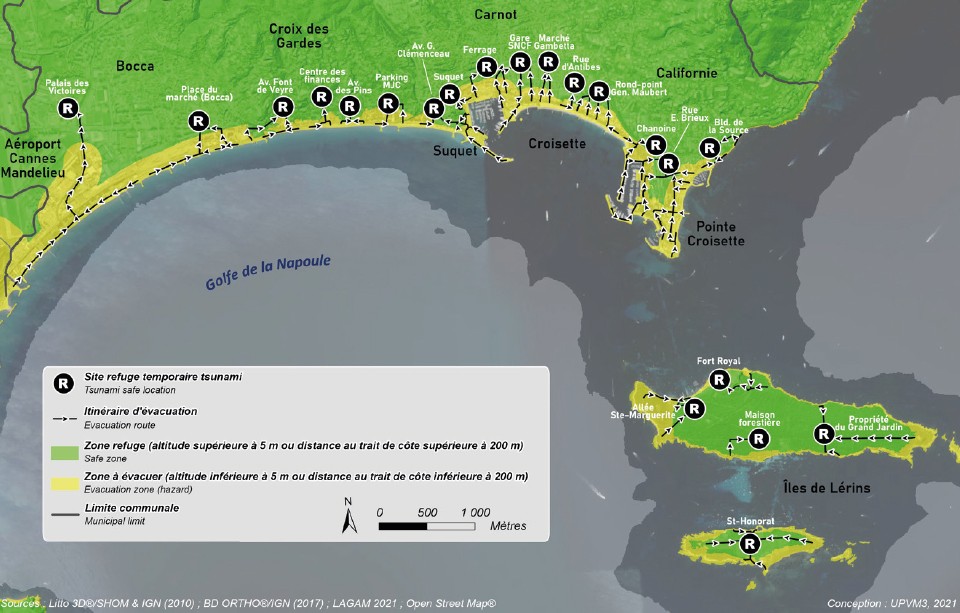
In Cannes, tsunami risk primarily affects areas close to the shoreline. The area at risk comprises low-lying land less than 5 metres above sea level and within 200 metres of the shore.


Tsunami risk prevention

Signposting evacuation routes to safe areas in the event of a tsunami warning

The Mairie de Cannes, a national leader in tsunami risk prevention, has mapped evacuation routes to safe areas so that people near the coast can reach safety as soon as a warning is issued.
 

Development of a tsunami risk charter

A charter on tsunami risk and coastal flooding in the Bay of Cannes was signed with local maritime professionals in November 2019 and November 2021, raising their awareness and informing them of the measures to take in the event of a tsunami warning.

Monitoring forecasts

CENALT (FR) (Tsunami Warning Centre) monitors earthquakes and tsunamis that may occur in the western Mediterranean and the north-eastern Atlantic. The centre alerts the national authorities responsible for civil protection whenever there is a tsunami risk. CENALT determines the alert level, with each level taking into account the maximum tsunami wave height forecast along Mediterranean coastlines.


 Cannes is Tsunami Ready

Cannes has been awarded UNESCO’s international Tsunami Ready recognition, becoming the first municipality in mainland France and the Mediterranean to receive this distinction.


〈 Back