Earthquake

Understanding the nature of the risk

The Mediterranean basin is where two major continental plates meet: the African and Eurasian plates. Although south-eastern France lies some distance from the boundary between these plates, it is nevertheless affected by their convergence. Seismic tremors, which are not always felt, are regularly recorded in the region.

Over the past thirty years, around ten earthquakes with a magnitude greater than 4 have been felt along the French Riviera coastline, the most recent occurring north of Nice on 18 March 2025, with a magnitude of 4.1.

What to do

Before an earthquake: be prepared

  • Ensure that any new construction complies with earthquake-resistant building standards, and have a structural assessment carried out before making any changes to the building’s structure
  • Locate the gas, water and electricity shut-off points
  • Secure heavy appliances and furniture
  • Identify a place where you can take shelter (near load-bearing walls, etc.)
  • Prepare your emergency kit: a radio and fresh batteries, a powerful torch, a first-aid kit, some food supplies and drinking water

During an earthquake: get to safety

If you are inside a building:

  • Take shelter near the corner of a wall, beside a load-bearing column or under sturdy furniture
  • Keep away from windows and glass panels

If you are in the street:

  • Move away from buildings and bridges that could collapse. If this is not possible, take shelter under a porch
  • Move towards an open area, watching out for falling objects
  • Keep away from power lines

If you are in a car:

  • Stop, if possible, away from buildings and power lines
  • Stay inside the vehicle until the shaking stops

After an earthquake: remain cautious

  • Turn off the water, gas and electricity supplies
  • If there is a gas leak, open windows and doors and notify the authorities
  • Do not light any flames or smoke
  • Evacuate the building using the stairs, not the lift
  • Your children are being looked after at school: do not go to collect them
  • Move away from the coast, even long after the shaking has stopped (tsunami risk)
  • Keep listening to local and national radio stations
  • Report any damage to your insurer and find out about compensation procedures

Compensation procedures following a disaster

  • Report your claim to your insurer without waiting for the official natural disaster declaration to be published
  • Report the damage to the Mairie de Cannes, which will ask the Préfet des Alpes-Maritimes to seek official recognition of a natural disaster
  • Wait for the interministerial order recognising the natural disaster to be published in the Journal officiel (available at www.legifrance.gouv.fr)
  • Within 30 days of the order’s publication in the Journal officiel, submit your final claim to your insurance company. Supporting documents should include your contact details and insurance policy number, the date and exact nature of the incident, a detailed description of the damage, an initial estimate of losses, photographs of the damage, invoices, repair quotations, etc.
  • Wait for an approved loss adjuster to visit and assess the cost of the damage

If the conditions of cover are met, compensation is paid within 3 months of the submission of the estimated statement of losses and the publication of the interministerial natural disaster order.

Property covered by insurance:

  • Buildings and fixed property: walls, floors, ceilings, fixed installations, fences, gates and outbuildings
  • Vehicles: covered under a policy that includes damage cover or comprehensive cover, or a specific policy extension

Stay informed and protect yourself

Register for Cannes Alerte

The city hall has introduced a system to notify residents by telephone in the event of an alert.

To register, simply complete the dedicated form and choose how you would like to be contacted in the event of an alert.

By clicking the button below, you will leave Cannes.com and be taken to a secure external page.

register for alerts


You can also follow weather alerts in real time via the myPredict2 app.

Other alert systems: sirens, announcements over loudspeakers, digital screens across the town…

Stay informed in real rime during an alert

Consult Cannes’ Document d’information communal sur les risques majeurs (DICRIM)

Cannes is exposed to 20 major risks. To raise awareness among all residents of the different types of risk and the appropriate actions that can save lives, the Mairie de Cannes has published its Document d’information communal sur les risques majeurs (DICRIM), a municipal guide to major risks.

Download the document (FR)

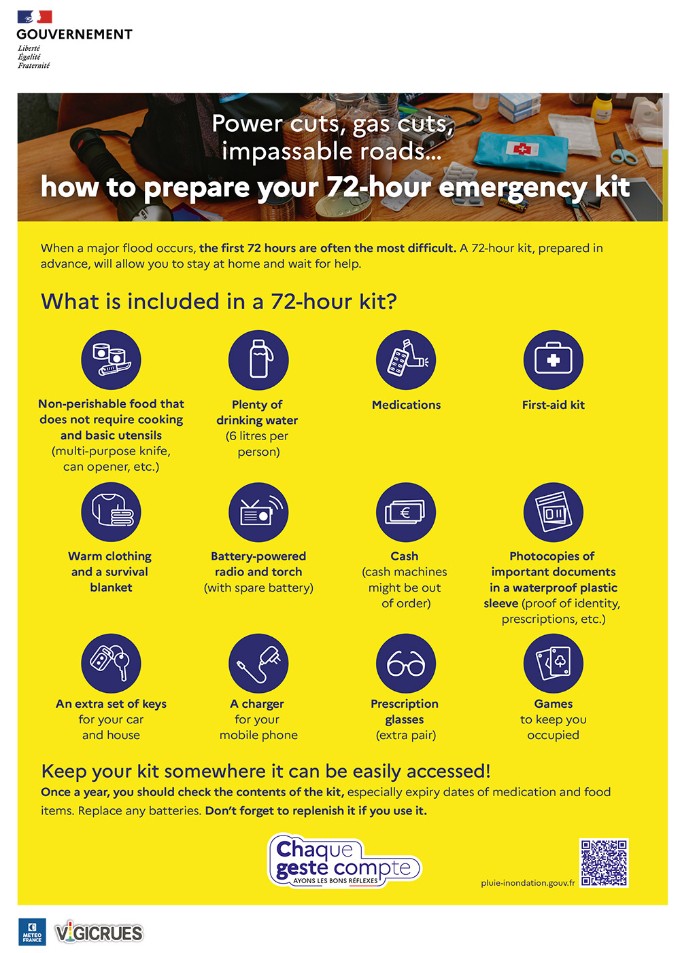
Prepare your 72-hour emergency kit

The 72-Hour Emergency Kit

Power cuts, disruptions to gas and running water supplies, impassable roads… when a major disaster strikes, the first 72 hours are often the most challenging. Preparing this kit in advance will help you stay at home with greater peace of mind while waiting for help to arrive. It will also be invaluable if you need to leave at short notice.

Here is what to include in your kit:

  • a battery-powered radio (with spare batteries) to follow instructions from the authorities
  • medications
  • a first aid kit (antiseptic, plasters, sterile dressings…)
  • basic tools (a multi-tool, tin opener…)
  • non-perishable food that requires no cooking (tinned food, jars of baby food, pet food…)
  • warm clothing and an emergency blanket
  • a torch (with spare batteries), candles, a lighter or matches
  • a mobile phone charger
  • a spare pair of prescription glasses
  • cash (cash machines may be out of service)
  • plenty of bottled drinking water (6 litres per person)
  • photocopies of essential documents in a waterproof pouch (identity card, prescriptions…)
  • spare house and car keys
  • games to pass the time.

Keep the bag somewhere easily accessible.
Check the contents of your kit once a year, particularly the expiry dates of medication and food. Replace the batteries too.

Remember to replenish your kit after use!
More information

Earthquake risk in the region

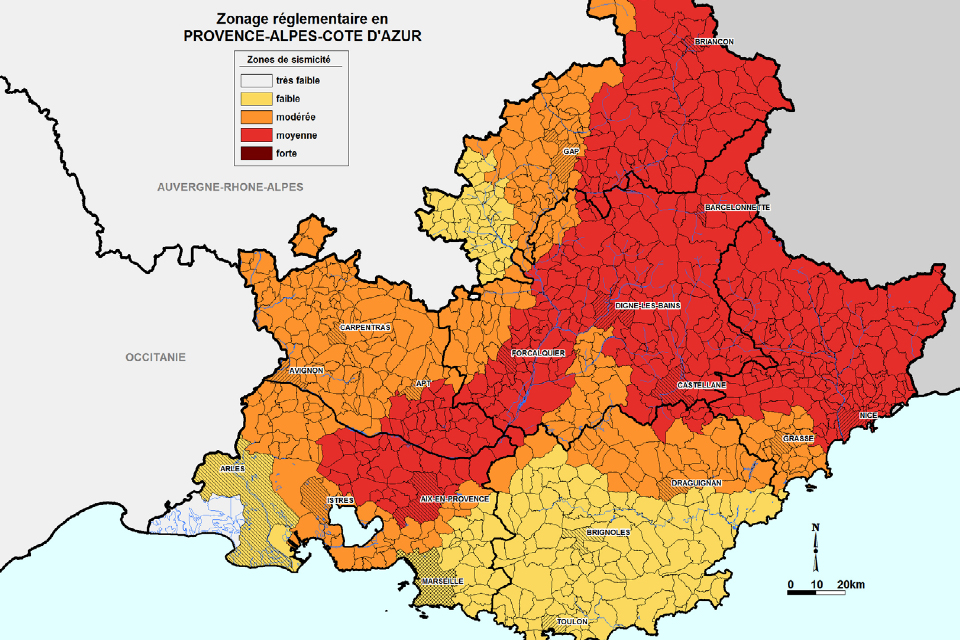
Cannes is classified as zone 3 under the national seismic zoning system, corresponding to a moderate level of seismic risk. From zone 2 upwards, earthquake-resistant construction standards apply to buildings.
 

Earthquake risk prevention

Prevention relies on compliance with current earthquake-resistant construction standards (Eurocode 8), which are mandatory for all building permit holders. More

Monitoring seismic activity

Earthquakes cannot be predicted, but they are continuously recorded by the Réseau national de surveillance sismique. When an earthquake occurs, this network works with the Bureau central sismologique français to produce a map of seismic intensities based on eyewitness observations.

Get real-time information on seismic events in France: https://renass.unistra.fr/fr/zones/

Have you felt an earthquake?

You can submit your observations at www.franceseisme.fr.

This macroseismic survey, conducted by the Bureau central sismologique français, records the damage caused and people’s experience of the earthquake in practical or qualitative terms, helping to determine the intensity felt.


 

〈 Back